

Case Study
Clever Market
Designing trust when 77% of Kazakhstanis didn't shop online - Five products built around a single promise.
$50M
Acquisition
170K+
Downloads
4.6★
Rating
Role
Founding Design Lead
Duration
2020–2022
Platform
iOS · Android · Web
Team
Solo → Team of 2
Scope
5 products · 120+ screens
The Name
Three entities, one
clover
The name came from the product's own structure. Three entities — buyer, seller, and platform — overlap at a single point: the shared experience. I doubled that intersection to mean "make online shopping twice as good," and the doubled shape became a clover — клевер in Russian.
Leadership anglicized it to Clever for the market. I made sure the original idea survived: the V in the wordmark is still a clover leaf, doubling as a heart. The whole thesis stays hidden in the logo.
The Problem
A market that didn't trust online
shopping
I joined as the first designer. The founders had a feature list. I asked
the harder question:
"Why would anyone use this instead of Kaspi,— Kazakhstan's super-app — or just going to the store?"
Around 77% of Kazakhstanis didn't buy online (consumer survey, n=200+) — not
because of technology, but because of broken promises.
"I don't need a million options. I need to know it will actually arrive before my husband gets home from work."
Aida, working mother · primary persona
Our job wasn't to build an app — it was to build confidence.
The Insight
Reliability beats selection
We tested "large catalog, 5–7 day delivery" against "curated, same-
day." Users chose same-day without hesitation.
✕ What we assumed
Bigger catalog = more appeal
Delivery is a logistics detail. Brand comes from
marketing.
✓ What was true
Smaller + reliable = trust
Delivery is the product. Brand comes from kept
promises.
Key Decisions
Four trade-offs that shaped the
product
Every decision involved a sacrifice. Here's what I chose, and why.
Decision 01
Promise first, deals second
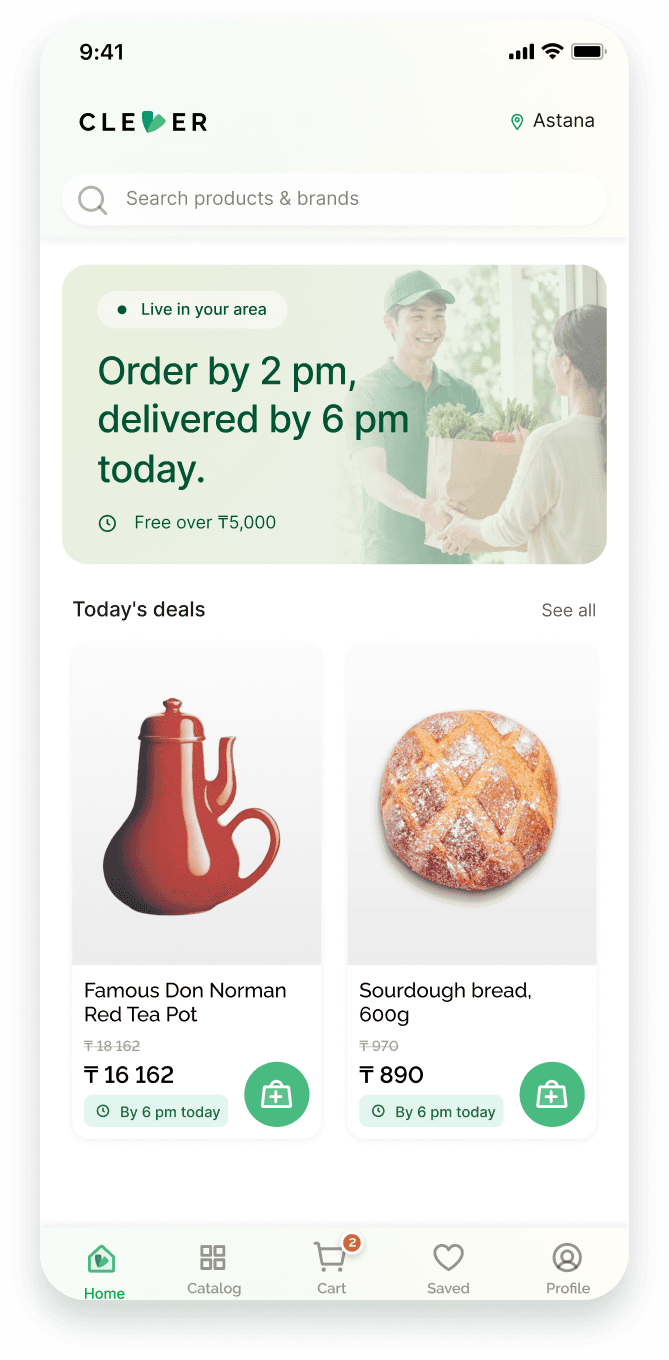
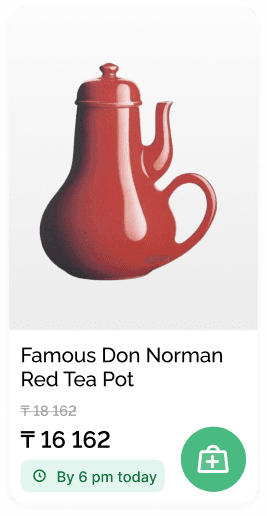
Marketing wanted deals above the fold. I put the delivery promise there instead — "Order by 2 pm, delivered by 6 pm today."
+34% session-to-order
Decision 02
One cart, not category carts
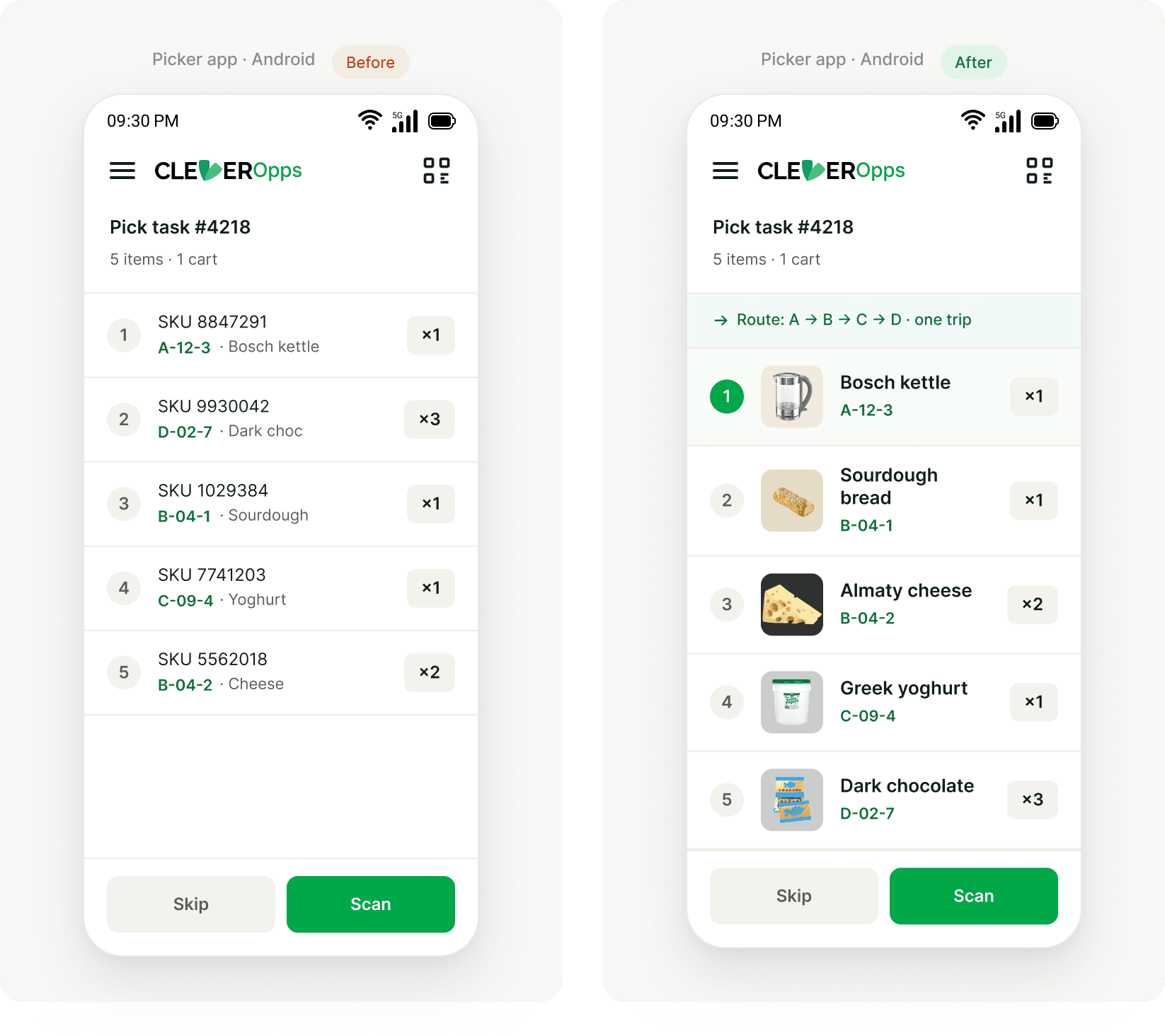
Ops wanted separate carts per warehouse zone. I pushed for one unified cart and re-engineered the pick list instead — when ops wanted to bend the user experience to fit the warehouse, I changed the warehouse.
12s → 7s per-item pick
Decision 03
Personal, not corporate
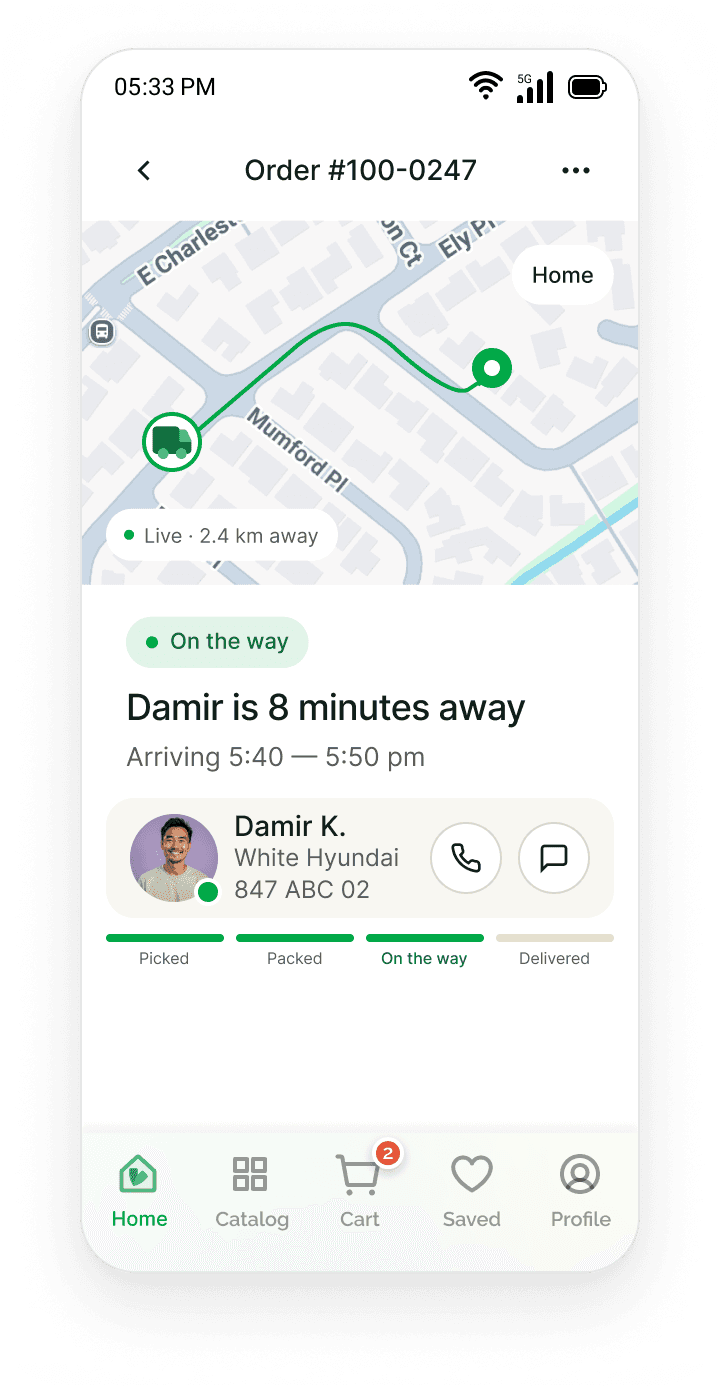
Changed "Track Order" to "See where Damir is" — the real driver's name, photo, and live position. Delivery stopped being a process and became a person.
+15% delivery satisfaction
Decision 04 · what I got wrong first
One promise, every surface
My first build showed delivery estimates only after add-to-cart. Research corrected me: "I need to know delivery time before I start shopping."
So the promise went on every surface — home, product cards, cart, checkout.
89% recalled the promise unprompted
Behind the Marketplace
Five products, one promise
The customer app was the front door. Behind it, I designed the
operational backbone that made same-day actually possible.
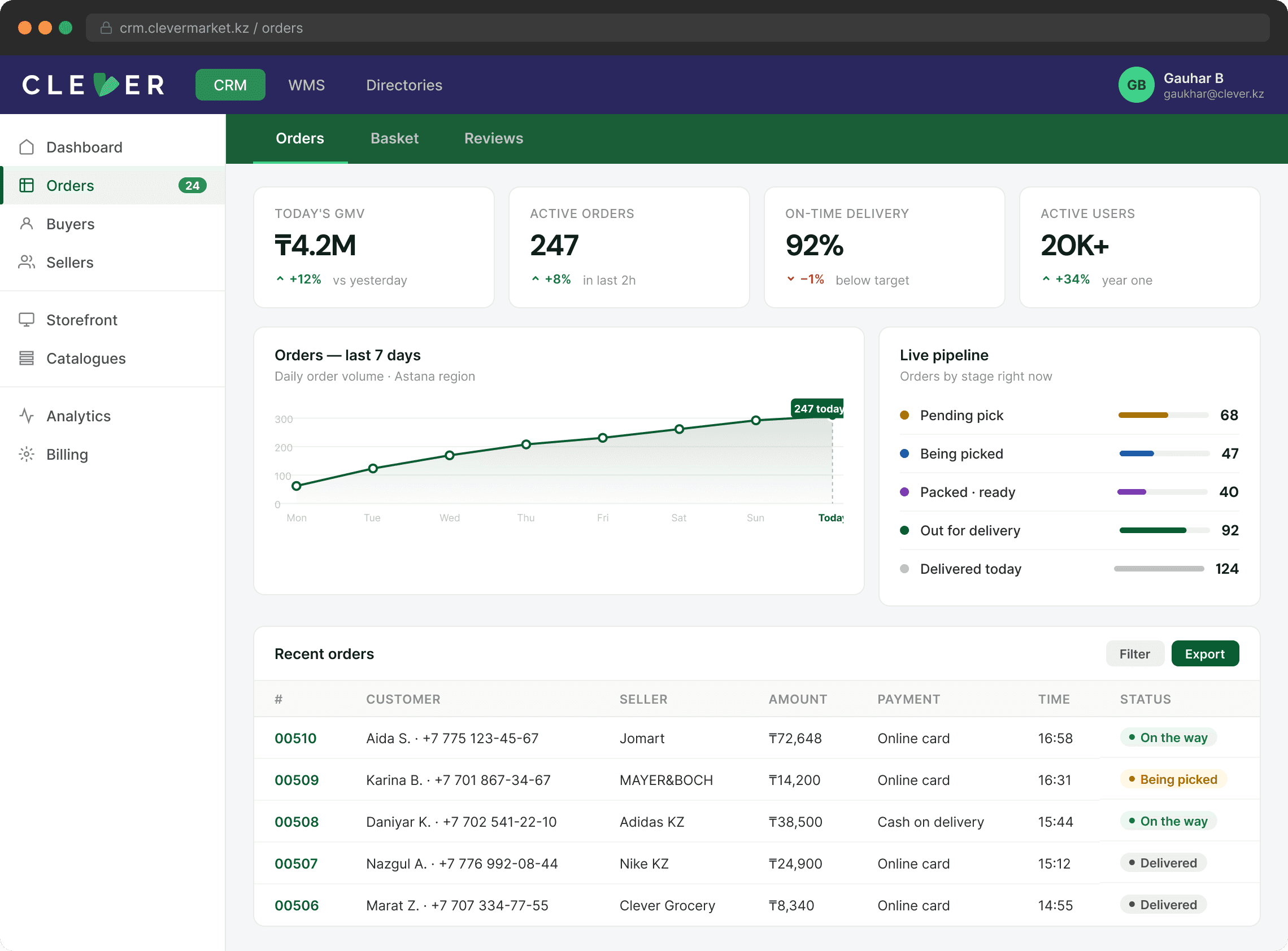
Admin CRM
Order pipeline, GMV, on-time delivery, live status across the whole
marketplace.
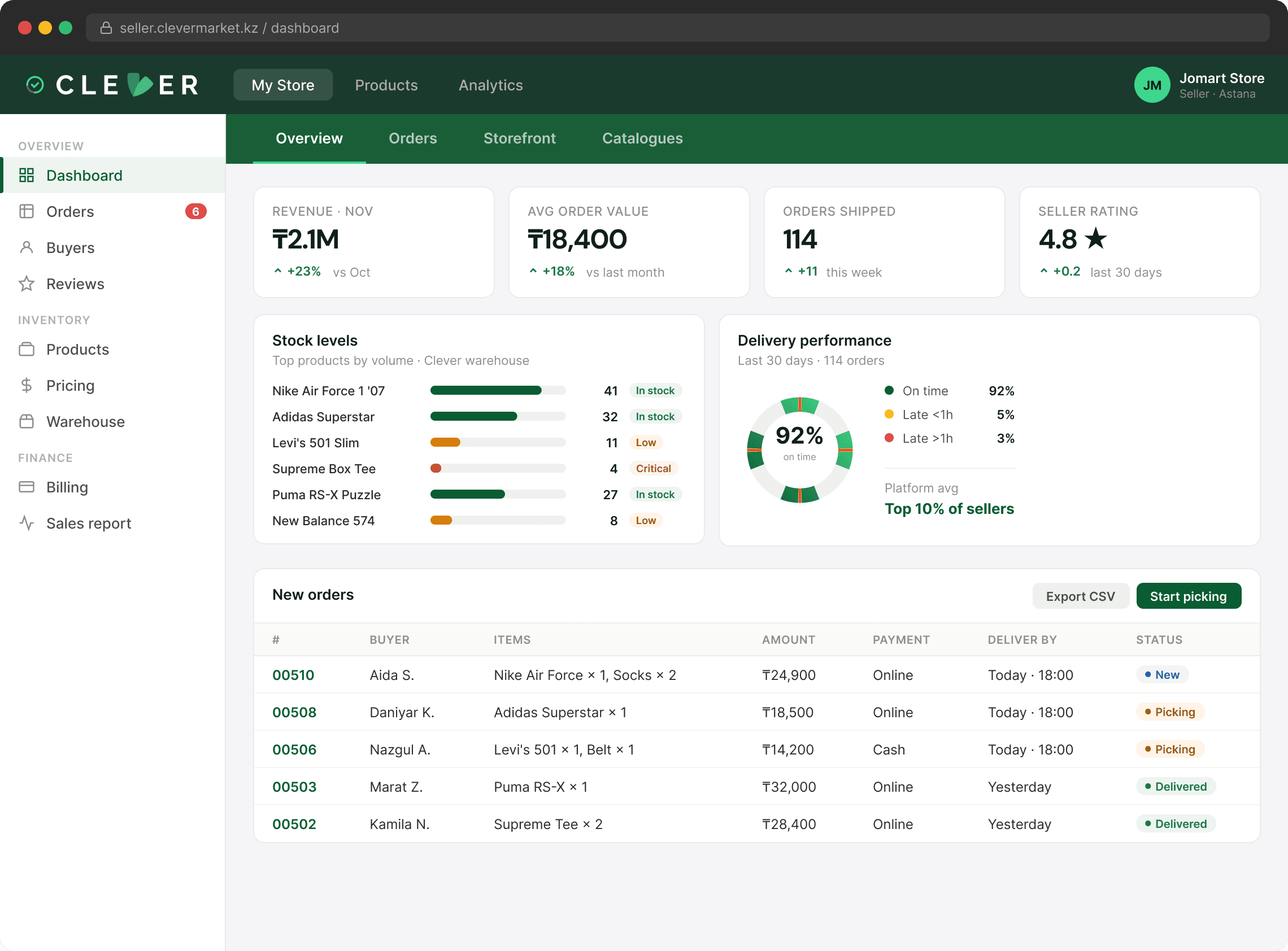
Seller Dashboard
Store overview, stock levels, delivery performance — e-commerce in a box for every seller.
One broken link breaks the promise. I designed all seven surfaces — buyer app and web, seller web,
CRM, WMS, picker, and driver — so the chain held.
Results
The numbers
20K+
Active users
Year one
73%
Checkout completion
3-step flow
7s
Per-item pick
~12s → 7s
4.6★
App rating
150K+ reviews
30%
Cart abandonment
vs 45% industry
+18%
Avg order value
vs projections
92%
On-time delivery
All orders Y1
$50M
Acquisition
Now Teez
Key Learnings
What I took away
01
Trust is the product, not features.
In low-trust markets, every micro-interaction is a trust signal. "Your driver is 8 minutes away" does more than any feature list.
02
Design the invisible.
The warehouse system wasn't "internal tooling" — it was the engine behind the customer promise. Beautiful apps fail if operations can't deliver.
Other Projects

Government | Enterprise

B2B Platform
Healthcare
VetTime
Pet healthcare platform. Emergency in under 60 seconds...
<60s
Emergency Booking
View Case Study

Academic | Gamification