

Case Study
Vacuumon
How a 10-Year-Old's Question Made Me Become a Designer
#1
Highest Rated
6
Countries United
2
Major Pivots
Team Leader & UX Designer · RWTH Aachen University · Germany
Prof. Dr. Jan Borchers' "Designing Interactive Systems" course

Vacuumon is Happy!
Fed 3 hours ago • Room is clean
Abstract
Children resist chores because chores ask for effort without offering care in return. Vacuumon reframes vacuuming as pet care: a vacuum cleaner with a small creature living inside it that feeds on the dirt the child collects. This study documents six weeks of iteration — including three abandoned concepts — and the moderated testing that shaped the final design. Its central finding is methodological: the metaphor at the heart of an interaction must be tested before anything is built.
1 · The Moment
Four words that changed everything
What a child's confusion revealed about the work.
"Do cats eat dust?"
The ten-year-old stared at our prototype, then looked up with genuine confusion. Six weeks of work. Dozens of sketches. A character we believed was perfect — cute, familiar, universally likable. A child broke it with four words.
That was the moment I understood what design actually is. Not making things pretty, and not following best practices, but listening until someone shows you what you missed.
My daughter will spend an hour feeding her dolls but won't spend five minutes
putting clothes in a hamper. The pet needs her. The hamper doesn't.
— Mother, from our user research
This reframed the entire project. We were not designing for cleaning. We were designing for
connection.
2 · The Insight
The hamper doesn't need her
Why cleaning fails as an activity, and what would fix it.
Children lack intrinsic motivation to clean because the task offers no immediate reward, no
feedback, and no visible sense of progress. We examined the problem from three angles.
Why vacuuming is the
worst
You push a loud machine around a room. You cannot watch the dirt
disappear. The payoff — a clean room — is abstract and delayed. There
is no emotional connection to the act.
The Tamagotchi effect
People wake at 3 a.m. to feed a handful of pixels and grieve when those
pixels die. The reason is simple: the thing needs them. Maintenance stops
being a chore and becomes care.
The reframe
If the vacuum held a creature, and that creature ate the dirt the child
collected, then vacuuming would no longer be cleaning. It would be
feeding a pet — and children want to care for their pets.
3 · Iteration
We killed our ideas before they killed us
Three concepts abandoned over six weeks, and why.
Timeline
Concept
Outcome & reason
Week 3
Gardening Zombies
Killed. AR projection turned weeds into zombies;
gardeners rejected the violence — "I garden for peace."
Week 6
Cat Character
Killed. Cute and familiar, but the metaphor collapsed
under one question: "Do cats eat dust?"
Week 7
Three-Eyed Creature
No real-world referent means no cognitive dissonance.
Children understood it immediately. ✓ adopted
Final
Vacuumon System
A vacuum with an embedded display, a creature with
moods, and a death mechanic that gives the care real
stakes.
4 · The Experience
The same moment, two outcomes
Jun is twelve. He loves games and hates chores. What changes is not the task — it is the
motivational architecture around it.

2a. Before — flow. Speed, challenge, play.
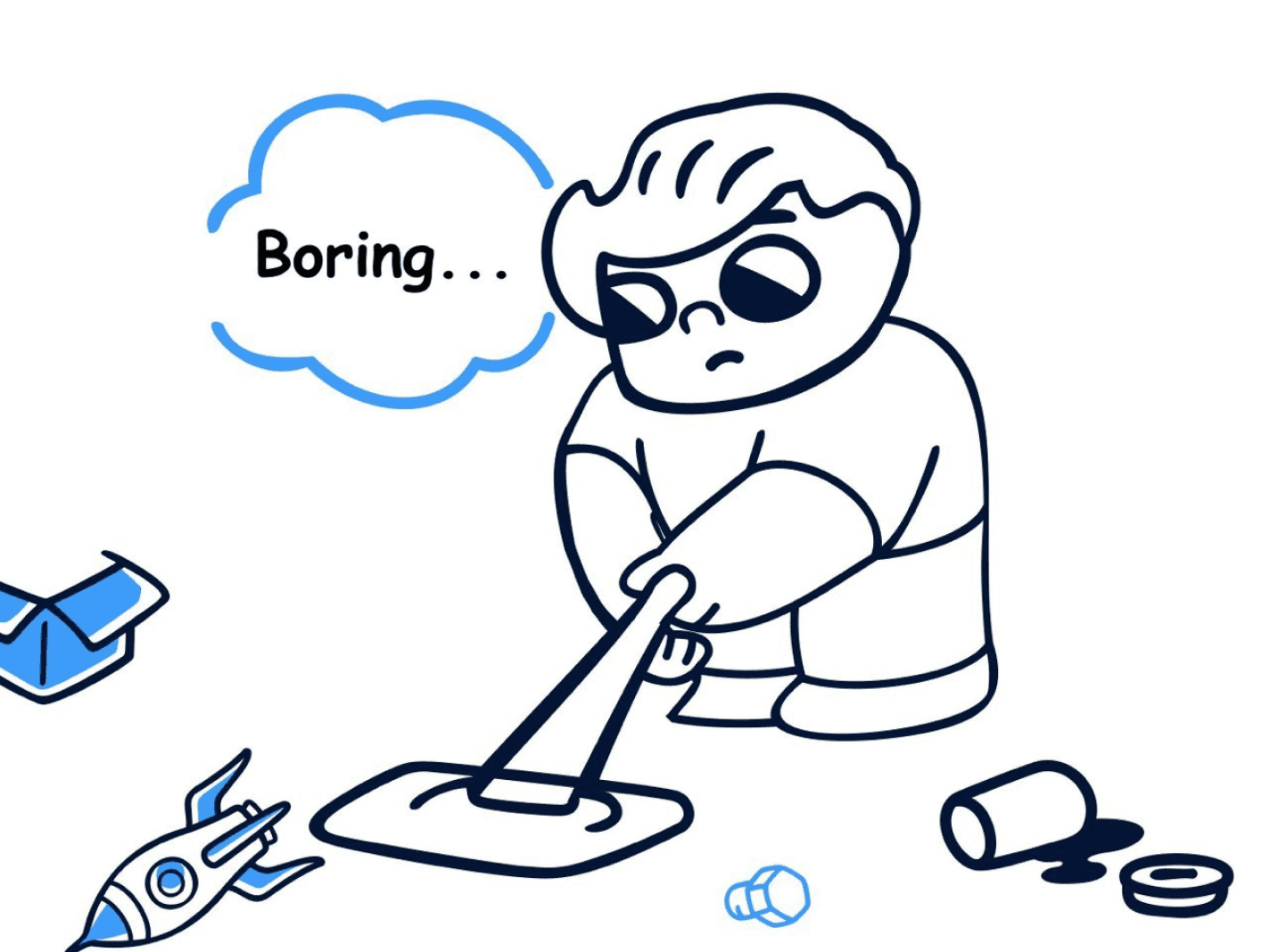
2b. The interruption. "Clean your room." The energy
drops; one word remains — boring.

Figure 3. The pivot — from external pressure to internal motivation.

4a. The reframe. "Let's play together." The vacuum
becomes a companion; the task becomes a mission.

4b. Mission complete. The room is clean and the creature
is fed — not because Jun was forced, but because he
engaged.
5 · Evaluation
Two children, watched closely
A small, deliberate study — depth over scale.
We ran moderated think-aloud sessions with two children, ages ten and thirteen. The sample
was intentionally small: the aim was to observe precisely where the metaphor landed, not to
produce a statistic.
<30s
To grasp the metaphor,
with
no explanation given
.
Unprompted
Both children narrated the
creature's feelings aloud —
"it's hungry!"
Both
Continued the interaction
without being asked to.
Moderated think-aloud sessions, ages 10 and 13. A small sample by design — chosen for observational depth rather
than statistical significance.
7 · Discussion
What this project taught me
Test the metaphor before building
"Do cats eat dust?" could have surfaced in week one with a single sketch test, saving weeks of
work.
Kill your darlings early
Gardening Zombies had three weeks invested in it. Abandoning it was painful, and it was correct.
Diverse teams reach better solutions
The fictional three-eyed creature emerged from teams multicultural design background, not from
consensus.
Design transforms feelings, not only interfaces
The same physical action — vacuuming — became something entirely different once the emotional framing changed.
Why this project still matters

"Design can change how people feel about things
they have always hated."
An academic project from 2012 — no app-store metrics, no revenue, no users beyond our sessions. But every project since (Clever Market, MindLogistics, Baiterek, VetTime) begins with the same question it taught me to ask: what is the emotional transformation we are designing for?
Other Projects

E-Commerce
Clever Market
Kazakhstan's first same-day delivery marketplace. Designed trust when 77% of the population didn't shop online.
$50M
Acquisition
View Case Study

Government | Enterprise

B2B Platform
Healthcare
VetTime
Pet healthcare platform. Emergency in under 60 seconds...
<60s
Emergency Booking
View Case Study